Friday, November 7, 2014

IT scenarios before & after OPEX BPM µBPO or from user dependency to control by the system


Although it is really heavy to accept, in fact everybody prefers better not to talk about, after enormous efforts that lasted not less than 30 years, one full generation, and veritable fortunes spent; the day to day operations of most of the traditional business depends, essentially, on what people is doing even manually or manually transferring information from one to another silo of information.

The following figure reflects this typical current scenario:


One could say, OK, no problem: “our competitors are more or less in the same situation”, “we have been very disciplined buying every single new miraculous tool that hardware and software vendors have recommended us, then, we are 100 % automated, really at the technological edge”, “why to change when we are leaders in our market, our sector, our segment, our town, our neighborhood or our “whatever”? 

Remember my words, one day these people will wake-up, have a look at the window and see a Google or Amazon drone knocking at the window glass trying to sell them at half the regular price the product they are so proudly and profitable selling in their close, protected, comfortable niche for years when not decades. 

This is not a nightmare, is just happening quarter after quarter in many different sectors they have been till now feeling fully protected forever with apparently indestructible barriers (distance, taxes, lack of information, human-local service required, language, regulations, size, excellent personal service or whatever, …). What happens that has destroyed this Arcadia? We could easily say: “Is the technology stupid”!

The question is: What do we have to do to compete with business born already 100 % automated? Surrender? Go on vacations? Retire yourself to the mountains? Just waiting this fashion will pass away? Change to another sector not yet under threat … for a while? 

The answer is very easy, innovate in business process automation, fight with the same arms, use your advantages being small flexible, quick deciders, imaginative … 

“But this requires very sophisticated knowledge out of our scope and supposes big investments affordable only for the biggest corporations, …

Excuses! Look at the next figure:


You need only to install an additional technological piece between your current silos of information and your users, the BPM Layer, and make an intelligent use of your business knowledge and innovation skills by continuously applying the OPEX > BPM > µBPO value chain to your operations reducing your indirect personal costs by a 70 % as we resume in this last figure:


“But Sir, to follow your recommendation we would need to buy the different software and hardware pieces, integrate it, contract consultants technicians to develop our BPM applications and support all this infrastructure on a 24/7 level of service but we can’t afford this!” 

Not at all! Go BPaaS (Business Process as a Service), everything served from the cloud paying a monthly fee just for the demanded consumption of the required resources. With no investment at all, no delays, no minimums, no complications, no short-mid-long term compromises, paying on a monthly basis not more than one fourth (< 25 %) of the tangible savings obtained. 

Does it sounds good? Go ahead now! Don’t lose time, remember, a drone is on the way to your backyard, if you allow it to invade your business niche by not drastically improving your operations now, with no delay.


Thursday, November 6, 2014

The Paradigm Shift - from Function in traditional organizations to Process in Extended new organizational scheme


Globalization, improvement in communications and the universal availability of mobile devices have boosted a dramatic paradigm shift on the way organizations are acting and on the IT architecture that has to support their operations. 

This change is summarized in the following diagram where we represent the evolution form the traditional pyramidal organization based on the Function assigned to each person to a new extended concept of the organizations where each person is acting in different processes with different roles.


In the new extended organization paradigm, internal applications are interconnected with external ones belonging to suppliers, clients and services outsourcing companies; communications are essentially structured and internal and external users are interchanging data and contents in real time from everywhere and being all this constant traffic governed by BPM processes.

The reason for that is clear: the actors in an organization and their behavior has completely changed to an opposite situation as is summarized in the following table:


This new paradigm has a big impact on the IT concept and architecture passing from having its focus on assuring the log of transactions to a new main mission consistent on supporting the automation of the procedures; or, in other words, passing from a very “solid” imperative way to manage the organization to a collaborative model that we could qualify like “liquid” or even “gaseous”.


Wednesday, November 5, 2014

Organizations wants to deploy an average of 6 #BPM_Process per year. Proceedit methodology & technology facilitates to achieve this rate


According to the results of our BPMS, BPM & BPaaS Market Survey 2014, organizations want to deploy and average of around 6 new BPM Processes per year.

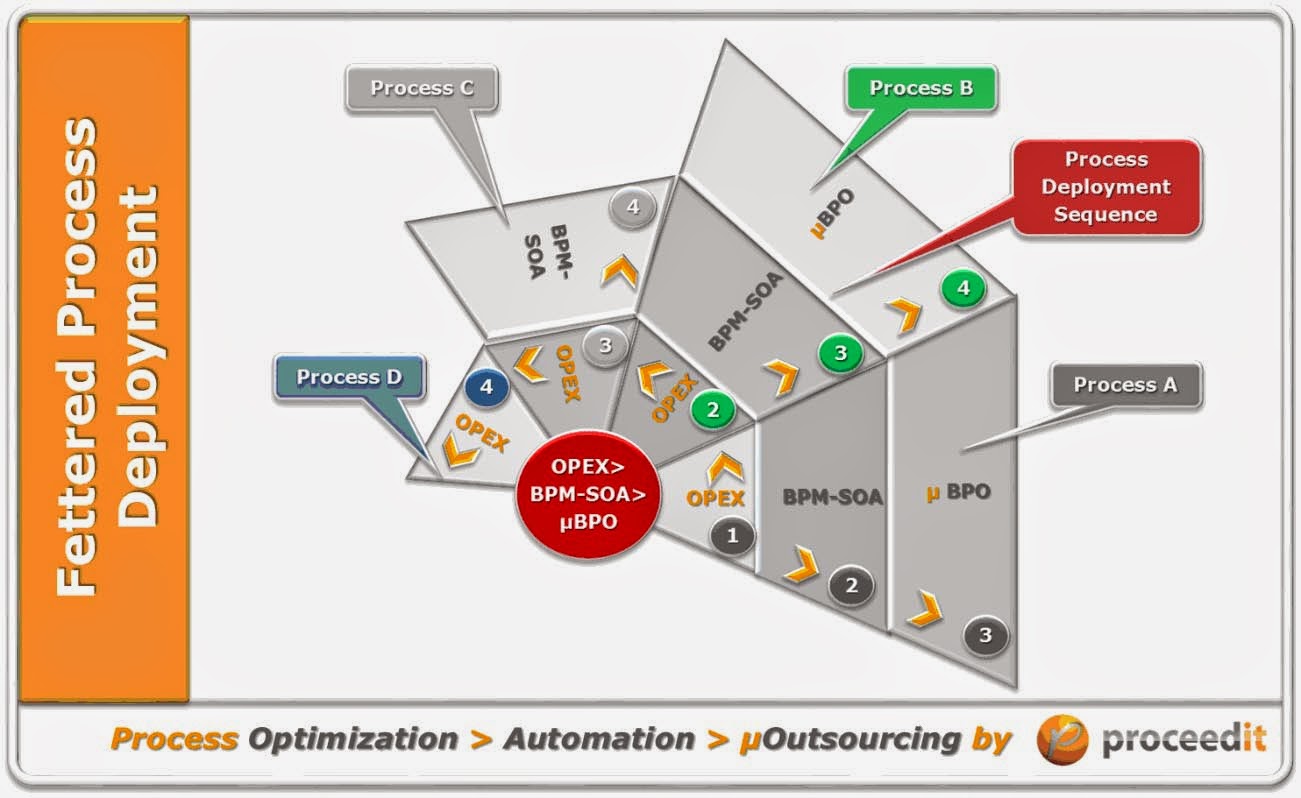
The methodological & technological proposal of proceedit permits to achieve this rate by enchaining the successive work of three specialized teams respectively on OPEX, BPM-SOA and microBPO disciplines, like it is shown in the next figure:


As a result of the application of the above indicated strategy, the following BPM Process deployment planning can be obtained:


This represents a rate of one new process implemented each two months that is aligned with the average aim of the organizations. In case the organizations wants to speed up this rate, additional set of specialized teams can be allocated and then double or triple the BPM implementation rate.

Tuesday, November 4, 2014

dyPAS by proceedit proportions 8 key advantages in full life cycle of BPM Process Class: development, customization, operation, support and maintenance


The dynamic Process Application Server (dyPAS) platform developed by proceedit to provide fast, agile, adaptable on the fly and reusable standard BPM Process Classes in combination with any BPMS platform available in the market provides 8 main advantages to end users as it is described here below: 
1. Full customization. 100 % adaptability to client/user/device requirements therefore increases the usability of the solutions and boost the BPM Process adoption success. 
2. Effortless. Reduces drastically (to 1/10) the development and maintenance efforts then lowering time to market and reducing operating costs. 
3. Increases agility. Proportions agility and flexibility in development, operation and maintenance phases.
4. Allows reusability. Permit the reuse of the same BPM Process Classes for all customers interested on a multitenant solutions environment and then reducing the usage cost. 
5. Less complexity. Reduces to 1/10 system complexity in terms of data models and forms to support as described in the next figure: 
6.  Lowers administration charges. Reduces deployment and administration efforts by applying the continuous single version concept.  
7.  Real-time adaptability. Allows instant changes on the fly at BPM Process Instance and/or at BPM Process Class level.

8. Easy BPMS migration. Reduces development effort on BPMS platform to less than 20 % > Facilitates BPMS platform migration > reduces risk of which BPMS vendor decision and further dependency being this specially important when it is expected than around 80 % of the currently existing BPMS software will disappear during the next five years. 


As a summary, developing BPM Process Classes with the proceedit approach combining dyPAS for managing and serving on the fly dynamic views of Forms, from Rules and Data Models, in combination with the powerful workflow management capabilities of the BPMS platforms, provides a winning framework to achieve massive, affordable and sustainable BPM deployment. 


Monday, November 3, 2014

Proceedit dyPAS creates automatically standard and dynamically customizable BPM Process solutions allowing them to act glocally serving all type of organizations with a single fixed BPM Process Class


The arguments for standardization of common processes are compelling: all the process actors have a consistent interface; huge economies of scale in IT analysis, development and Integration are obtained; operation, monitoring, tracing, audit and document control are homogenous and then even outsourceable; process improvement, change management, training, performance measurement and quality assurance are improved with much less effort. 

Are these benefits enough to sacrifice local variations that respond to local needs and then having to decide between the global-local dilemma? Answer yourself, this is not an easy decision, indeed.

The arguments for serving the specific users requirements and then allowing and managing local and personal variations in standard processes are, not only persuasive, but a key factor of success for the massive adoption of BPM by eliminating one of the main barriers customers have against standardized solutions, not only to BPM ones:

“We are especial, we do the things in a very different way than our competitors and therefore, we want to work as we have decided to do. We are so especial that is not possible that a standard solution can be adapted to our needs. We don’t want to be obliged to adapt our operations to standard predefined working procedures because acting in such a way we will surely lose our competitive advantage”.

By chance, have you heard these words or similar ones before? Frankly speaking, do you really thing this is true? The same reticence applied to ERPs for years and finally standard solutions have clearly dominated this market.

dyPAS (dynamic Process Application Server) developed by proceedit solves the standard-custom contest by giving a consistent solution to BPM Process Classes standardization, without renouncing to serve the strong customization requirements that users are demanding and then resolving this dilemma in an efficient, robust, flexible, affordable and sustainable way.

BPM Process Classes created with and served by dyPAS look in the front office (when acting with persons, applications, machines, sensors and actuators) like a tailor made process solution but being, in fact, 100 % standardized BPM Process Classes from the back office point of view both in development, operation and maintenance phases.

In the way we represent in the next figure, this original proceedit approach allows that each single Process Class works in a “Glocal” modality being at the same time standard but custom adaptable to the specific requirements of all customers, independently of its size, sector and localization of the organization using the BPM Process Class.


Moreover, this approach works not only with horizontal common processes but also for the vertical specialized ones and for not only a fixed pre-established behavior but also performing dynamically real time adaptable reactions to the varying context situation without hard changes in the BPM Process Class.  

Finally yet importantly, development, customization and real time dynamic operation is done without any programming job at all! In other words, dyPAS technology follows an strict “0” code approach, in which, first by simply declare the solution to our engine to automatically create the BPM Process Class Form Server and then this is customized on the fly using different parameters, business rules and context variables describing the specific behavior of the BPM Process Class for each Process Task, Customer, User and Device connecting to the BPM solution. 
 

Friday, October 31, 2014

The dyPAS (dynamic Process Application Server) developed by Proceedit is being recognized as the best Methodology & Technology for BPM Process Standardization


With the traditional IT approach (tailor made projects for each customer) and the usual way to use BPMS technologies by BPM technologists (almost all the configuration of the process class, personal tasks forms, data model, business rules, automatic tasks, … is made on the platform), the effort for massive BPM adoption and the technological complexity generated (see next figure) by hundreds of Process Class that are required to deploy and maintain is simply not possible to afford by mid and small size organizations.


proceedit considers that the clue to overcome these tremendous barriers of effort and complexity goes through a drastic change of paradigm in the BPM Industry. Indeed, We stand for applying the new value chain Co-development > Standardization > Reutilization > Low Cost that is, in our opinion, the only way to achieve a massive, affordable and sustainable BPM Process adoption, especially when we are talking about the mid/low-end market.

After 4 years of intensive development, piloting and testing efforts, proceedit announces the availability of the first full operative version (already in operation) of its methodological and technological platform dyPAS (dynamic Process Application Server) that, combined with any of the BPMS platforms available in the market today, provides an easy to use and maintain, flexible, robust and resilient engine for BPM Process Classes standardization.

The dyPAS outcome is to manage in a fast, flexible and efficient way the definition, refinement and evolutionary change of the forms, views, data models, and workflows trough the usage of dynamic parameters & business rules associated with the automation of business processes. 

Using our dyPAS technology for BPM Process Classes development, we apply several methodological rules:

  •  Only one Process Class for each business process type,
  • Only one Form Class for each Process Class,
  • Real time dynamically generated Views of the Process Form Class customized on the fly at the instance level depending on: Process Task Class, Customer, User and Device requesting the form, and other contextual variables, parameters and business rules,
  • Unified Process Data Model (Business Ontology) for all Process Classes
  • Continuous unique version of each Process Class serving all customers but customized on real time, 
  •  ... and till nearly 40 standardization rules.
And this all managed from a single centralized system which handles the real-time behavior of all the forms and workflows of all automated processes in one or more organizations, both in terms of:
  • What information to display and how to manage it,
  • The Process Forms Views behavioral characteristics in front of the User depending on: the Process Task, the Client, the User and the Device from which the user accesses the system, and
  • The behavior of the workflow in each use case, depending on the real time business rules constructed and served on the fly, according to the present business scenario.
The above behavior is sustained in the architecture showed in the figure here below, being the main applied concept the separation in different areas and supporting platforms (BPMS and dyPAS respectively) what refers to Workflow management and what refers to the Data, Forms and Rules management.


Thursday, October 30, 2014

proceedit methodologies and technologies are the clue for full, efficient and resilient BPM Process co-development, standardization & reutilization and then permitting to eliminate the existing barriers for the massive BPM adoption


With the traditional IT approach (tailor made projects for each customer) and the usual way to use BPMS technologies (almost all the configuration of the process is made on the platform) by BPM technologists,  the analysis, development, integration, testing and implementation of a BPM Process Class of average complexity (around 20 tasks) supposes and average effort of around 1.000 man-hours*, including in this figure the efforts on the customer side to define requirements, testing and training users and administrators of the BPM Process Class

In addition to that, the evolutionary maintenance of each BPM Process Class consumes on a recursive many highly skilled business and technology human resources and then leading to hidden but high and frequently recurrent process operating costs that reduces the savings obtained by the implementation of the BPM Process Class.

Taken in account that an average sized organization has a list of around 200 business process to be automated in a first wave, this cumulated effort of around 200.000 man-hours per organization is the main real barrier that has avoided till now the massive adoption of BPM, especially in mid and small size organizations. 

proceedit considers that the clue to overcome this tremendous barrier goes through a drastic change of paradigm in the BPM Industry. In our opinion, as we show in the following figure, the value chain Co-development > Standardization > Reutilization > Low Cost is the only way to achieve a massive, affordable and sustainable BPM Process adoption, especially when we are talking about mid and small size organizations. 


In fact, the unique Business Model and methodological and technological approaches applied by the Multinational Technology Cluster proceedit when building and customizing BPM Process Classes, were created and had been successfully implemented specifically to implement the above value chain on an efficient self-sustainable way.

This is reflected in the following figure were we show how our dyPAS (dynamic Process Application Server) technology brings proceedit and its Cluster Members the capability to co-develop and standardize BPM Process Classes, and this permits the reutilization of these BPM Process Class among many customers, and this drives to drastic reduction of the process implementation/use costs which, in turn, makes this BPM Process Class affordable and sustainable, even for mid and small size organizations,  and then this fact feedback this virtuous circle by incrementing the reutilization of the Process Class and again reduces cost and … in a never-end very powerful fedback booster of massive BPM adoption.


* Data obtained from the results of our BPMS, BPM & BPaaS Market Survey 2014. You can contribute to this survey at the following link: https://es.surveymonkey.com/s/LHKY2FL

If you are interested, you can see partial preliminary results of our BPM Survey at the following link: https://es.surveymonkey.net/results/SM-87TRMB6/